






For years, growth in the biogas industry has followed a familiar pattern.
Build more capacity. Secure more feedstock. Produce more gas.
But that model has practical limits. Feedstock is finite, permitting takes time and expanding existing plants requires capital. That raises a different question for plant operators – can more value be created from the gas, beyond what already exists?
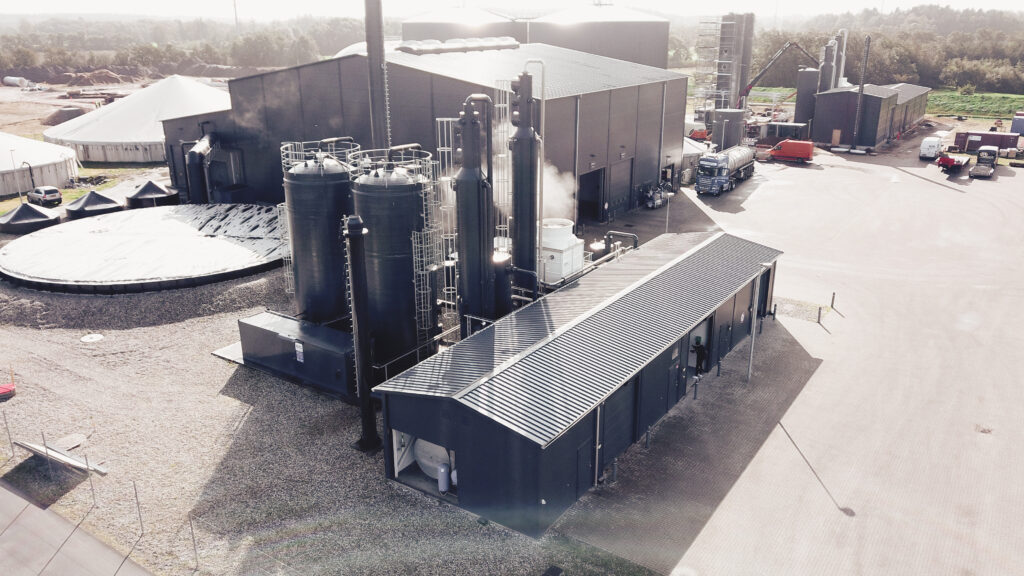
At Nature Energy’s Glansager facility in southern Denmark, that question has led to a different way of looking at one of the main components of biogas.
Carbon dioxide.
Instead of treating CO2 only as something to remove during upgrading, the Glansager project uses it as a raw material for producing additional methane.
CO2 becomes part of the feedstock
Raw biogas contains both methane and carbon dioxide. In conventional biomethane production, CO2 is separated from the gas to increase its methane concentration. At Glansager, Biogasclean’s BE-X technology takes a different approach.
The process combines biogenic CO2 in the biogas with hydrogen produced using renewable electricity to produce electro-methane, or e-methane, through biological methanation. This can result in up to 78% more biomethane from the same amount of feedstock.
Increasing renewable gas production would normally mean securing more feedstock. At Glansager, the aim is instead to recover more energy from the feedstock already entering the plant. This is more efficient and more profitable.
From biogas plant to Power-to-X plant
Green hydrogen is introduced into the process together with the biogenic CO2 from the biogas. Inside the biological, chemical free, methanation system, microorganisms convert the hydrogen and CO2 into methane, water and heat.
The hydrogen is produced by electrolysis using renewable electricity from sources such as wind and solar. In this way, electricity that might otherwise be difficult to store can be converted into e-methane.
Nature Energy expects the Glansager plant to produce between 2 and 3.5 million cubic metres of e-methane annually, with the transport sector identified as a main customer for the gas.
The project connects two renewable energy systems that are often discussed separately. Biogas provides the biogenic carbon, while renewable electricity is used to produce the hydrogen. Biological methanation brings the two together as a storable gaseous fuel.
The significance goes beyond increasing biomethane production. The process also provides a route for converting renewable electricity into energy that can be stored and transported as gas.
Fitting new technology into an existing plant
For Nature Energy, the technology also had to fit into an operating biogas plant with existing equipment, gas flows and production requirements.
That was an important consideration when selecting the technology for Glansager.
Jeppe Bæk, Project Innovation at Nature Energy, explains:
“At the end of the day, Biogasclean was the only one providing this kind of process that fits most into our system.”
One advantage of the BE-X process is that it can work directly with untreated raw biogas without requiring a separate gas pre-treatment step before methanation.
The biological process can also ramp its capacity up and down as operating conditions change, while operating at relatively low pressure and temperature, which can help keep operating costs down. Integrating the technology into the existing plant also required engineering beyond the methanation process itself. Jeppe continues:
“Working with Biogasclean has been a really strong partnership. They are really strong on project execution and they’re strong on also engineering this site.”
At Glansager, Biogasclean’s role therefore extended beyond supplying the methanation technology. Engineering and integrating the process into the existing plant were part of making it work in commercial operation.
More output from existing infrastructure
For the wider biogas industry, Glansager raises an interesting question about where future production growth could come from.
It does not necessarily have to mean larger digesters, more feedstock or entirely new plants. Some of it may come from finding new ways to use more of what is already flowing through existing infrastructure.
Around 40% of raw biogas is typically biogenic CO2. At Glansager, that carbon is not simply removed from the gas stream. It is combined with green hydrogen to produce additional methane, using much of the biogas infrastructure already in place.
This can increase biomethane output by up to 78% without increasing the amount of feedstock and that changes the question for existing biogas producers. It is no longer only how much biogas a plant can produce, it is how much more energy and value can be created from what the plant already has.